
- News
- City News
- bengaluru News
- Pandemic art plays its role in spreading positive, life-affirming messages
Trending
This story is from May 23, 2020
Pandemic art plays its role in spreading positive, life-affirming messages
Thanks for all you’re doing. I hope this brightens the place up a bit, even if [it’s] only black and white.” Along with the framed picture of his work titled game changer,
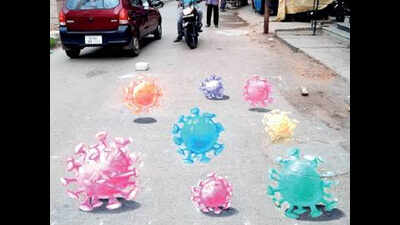
Three-dimensional graffiti of the coronavirus by Badal Nanjundaswamy
that has been created in the past two months, Banksy’s painting was one of the more popular works that tackled the Covid-19 pandemic and the havoc it has wrought.
Now, while the phrase maybe cringe-worthy there is such a thing as ‘pandemic art’ that takes inspiration from, and alsoconveys a glimmer of hope, when life seems unsure. The ‘genre’ isn’t entirely new either considering that certain iconic works and art movements were created during that other pandemic that happened over a 100 years ago:the1918 flu.
SPREAD THE MESSAGE
In early March, the United Nations chose to tap into the power of art. The international organisation along with arts group Amplifier launched an independent campaign to submit artwork that would ‘help share lifesaving information on Covid-19’. Over 17,000 contributions were received from artists in 143 countries.
Bengaluru-based graffiti artist Badal Nanjundaswamy may not have participated in the UN campaign but during the early phase of the lockdown, Nanjundaswamy found himself driven to do graffiti related to Covid-19. “During the lockdown every time I looked out the window, I saw how people disregarded the rules of staying at home. So, I decided to get out and create art with that message.” First came grafitti work outside his home in RT Nagar with Stay Home scrawled boldly followed by one more at a bus stand near his place. “I even had commissioner of police Bhaskar Rao come and write Stay Home for one of my works,” he adds.
Like Nanjundaswamy, Madhubani artist Avinash Karn, locked down in his studio in Benaras, has been regularly posting his Madhubani drawings related to the pandemic. These works reflect the issues related to Covid-19 that’s been happening across the country. “I was doing a work (Gratitude) on people clapping hands for the health care professionals,” Karn recollects. “That evening I read about some home owners evicting doctors from their homes. My incomplete work had some blank space so I used it to show the same.” Similarly, when the authorities sprayed disinfectant on labourers in Uttar Pradesh, Karn was provoked to make another painting. He asks, “Do we have disinfectants for upper-class wealthy tourists who had recently done foreign trips?” As gratifying attention is pouring on social media, the city-based Azim Premji Foundation has commissioned the artist to make Covid-19 awareness posters. Karn says that five of the posters are now being circulated amongst government school students promoting the idea Stay Home, Stay Safe. The posters are simple and effective. From hand- washing to playing games with the family during lockdown, the posters convey the message without much text or explanation. “The foundation has shared them with the parents of government school students via Whatsapp,” he notes.
Anu Menda, managing trustee of RMZ Foundation believes in the positive power of art. Which is why once lockdown rules were relaxed, Menda and team decided to spread awareness on the need to wear face masks in a slightly offbeat way: They decided to have a mask digitally rendered on Devi, the 1.5tonheavy iconic sculpture by G Ravinder Reddy that welcomes visitors in the lobby of RMZ Ecoworld. “The soft power of art was a decisive factor in why we chose to do it. Devi is one of our anchor sculptures and the digital rendering will be a constant reminder to people to wear their masks,” says Menda who may have plans to get an actual sculpture that is accessorized with a face mask.
ABSORB, REFLECT, RESPOND
The lockdown has been a busy time for artist Ravi Kashi with classes and creating new art but ask him if he has created anything based on the pandemic and he responds in the negative. I don’t believe in creating reactionary work he says, but his observations of the goings on may someday seep into his work. “The sad state of affairs of the migrants has impacted me. I’d recently shared some artwork that I had made when I was a student 30 years ago that reflected the plight of the labourers of the time. So, who knows, what I am seeing today may reflect in some work in the future.” As a graffiti artist, Nanjundaswamy’s art is mostly reactionary but he echoes Kashi when he says, “I may create something about the ongoing migrant crisis in the future”.
Looking at the kind of art we can expect in the near future, irrespective of the bad market, gallerist Pramila Baidof Gallery Sumukha says, “Considering artists have had a good two to twoand-a half months to themselves, you can expect to see good quality art in the coming months.”
(With inputs from Jayanthi Madhukar)
Stay updated with the latest news on Times of India. Don't miss daily games like Crossword, Sudoku, and Mini Crossword.
End of Article
FOLLOW US ON SOCIAL MEDIA



Photostories

Hot Picks
TOP TRENDING
Explore Every Corner
Across The Globe
Taylor Swift Eras TourPushpa 2 CollectionUPSC Mains Candidates ListBronson ReedBengaluru Techie Suicide
Brain Exercise to Improve MemorySavannah James WifeBooks to help StudentsCBSE Date SheetKim Kardashian
Popular Categories
Hot on the Web
Top Trends
Syrian Civil WarShaunie HendersonWho is Sanjay MalhotraIndian Cricket Team FanMilwaukee Bucks vs Brooklyn NetsWho is Luigi MangioneWTC Final Qualification ScenarioIPL 2025 Full Teams SquadRCB Team SquadDiljit Dosanjh Indore ConcertMike TysonHow to Apply Pan 2.0Kamlesh NagarkotiMumbai Bus AccidentMohammed SirajHarbhajan SinghUPSC Mains ResultLive Cricket Score
Trending Topics
Pushpa 2 America Box Office CollectionPushpa 2 ReviewAbhishek BachchanRubina DilaikBhool Bhulaiyaa 3 OTTViral NewsAmitabh Bachchan HouseOptical illusionSandeep Reddy VangaMukesh Ambani's Favorite FoodSnowfall in KashmirZodiac SignsHair RegrowSkincare Tips for WinterWeight Loss TipsHair FallMicrosoft 365 OutageNarayana MurthyElon Musk
Living and entertainment
Latest News
No DGCA CAT II/II exemption: Akasa late night to early morning flights at Kolkata & Bengaluru face uncertainty this winterSamantha Ruth Prabhu prays for loyal and loving partner, fertility and more post Naga Chaitanya's second marriage with Sobhita DhulipalaChhathi Maiyya Ki Bitiya Actor Ashish Dixit praises his on-screen dadi Abha Parmar: "She's the thread that binds us all together"INDIA bloc to move SC over EVMs 'manipulation' in Maharashtra pollsCollege girl gives birth to baby in Eluru district's hostelShocking! Toddler walks into traffic while mother films dance reelNovo Somvar festival celebrated at BicholimDid Donald Trump Jr send this birthday message to Bettina Anderson? Where is Kimberly Guilfoyle?Watch: Utah man rams car into dealership over 'as-is' policy dispute; arrestedCCP mulls hiring wardens to curb heritage tourism woesRealme 14x 5G to launch in India soon; design and colours teasedThese are the best fermented foods for weight lossBronson Reed and Tonga Loa OUT of WrestleMania 41? REPORTSFully implement new criminal laws by March 31 next year, home minister Amit Shah tells HaryanaLuigi Mangione: A glimpse at the Tinder profile of UnitedHealthcare CEO's murder suspectNorway plans FIFA protest over 2034 World Cup handed to Saudi ArabiaIs WWE Planning Another Major Feud?: CM Punk Rumored to Face Seth Rollins at RAW Netflix DebutNBA Trade Rumor: Golden State Warriors in hot pursuit of Miami Heat's Jimmy Butler, potential trade with Heat on the horizon
Copyright © 2024 Bennett, Coleman & Co. Ltd. All rights reserved. For reprint rights: Times Syndication Service